
Welcome to The Freak Show
On Sex and the City, dating, and letting go of control

“On a date and this man is so bubbly I’m realising I may be the issue,” I inform my friend Shaniya over iMessage. After sending, I glance up from my phone to watch my date walk off to the bathroom.
“LOL, in what way?” she replies.
I ask myself, what was it about this man that set me off the avoidant deep end only 15 minutes into our first date? In all honesty, he’s perfectly fine. An average interaction, on an average weekend, with an average stranger I’m meeting over coffee. I prefer this in case he turns out to be a serial killer or worse, a casual mansophere bot transformed into a real boy. I can hear the voices in my head scream out ‘low-value woman’, ‘being in your masculine’, and the dreaded ‘if he wanted to he would’. The pink pill is fended off by years of Tumblr indoctrination in equal footing in relationships, and yet, I feel a sense of guilt for not making him take me out somewhere fancy. I should avoid the cheque by turning my neck around until the skin twists like a screw. I should be giving him my address to get me an Uber instead of using my trusty Oyster card to journey towards the cafe we’re sitting in. Am I being too meek? Maybe I’m not meek enough. Or maybe I just need someone to save me from being the wrong kind of woman?
It could be argued that I’m like this due to low self esteem or a lack of belief in my own sauce and romantic viability—if that’s how you see the world. But my rebuttal would be, it’s because I don’t trust men any further than I can throw them, and unfortunately, I can’t throw very far, though I am working to change that. My lack of trust is firmly rooted in years of parental handwringing on how I shouldn’t be talking to men in the first place, lest they mislead me into an uncompromising position. My parents made sure I was aware that all men have underlying reasons to trick, cheat, mistreat and lie from the moment I hit puberty. Why assume you’re the special one it won’t happen to?
What I think they were saying, and I know my parents wouldn’t use this word, is that men are freaks. Selfish, manipulative, dangerous freaks so frightening they make your sleep paralysis demon seem friendly. And unfortunately, I somewhat agree, and not in any rational or even feminist sense, I don’t believe in bio-essentialism. I understand that misogyny and all its byproducts are socialised rather than inherent. But so much of my time dating has been spent wondering if, and in all honesty, hoping that the men I interact with turn out to be freaks, including the stranger on this date. Not the kind my friends and I would giggle about over dinner, but the unadulterated oh my god, what a freak! kind that you relay when you get into the bad dates portion of the night, where you swear off dating as a whole until it inevitably draws you back in again.
Is this man talking to me about his favourite childhood movies a freak? I mean, he doesn’t seem like one, given his attempt at being nice by showering me with compliments about how funny and cool I am. He has a decent job, and from his description, his relationships with friends and family remain intact. Most pressing of all, he has yet to neg me—surely I had a good enough radar at this point to detect someone suffering from dating deficits. Yet, I’m waiting for the other shoe to drop, the reality that he is simply every man in the same way Whitney Houston and Chaka Khan were every woman. Is he a misogynist? A creep demanding I go home with him? Are his compliments a pathway to the dreaded “You know you’re really pretty, right?” Which, might I add, feels like a trick question where I have to confirm his attraction towards me, rather than it being straightforward.
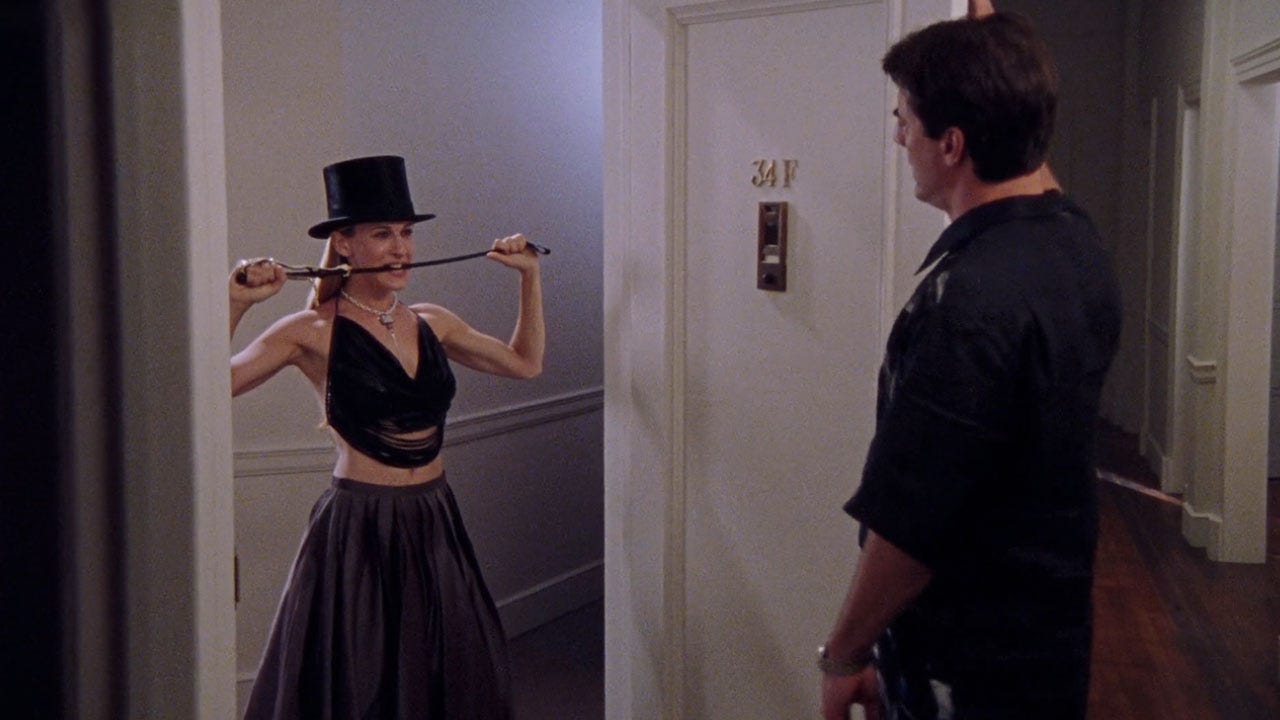
I’ve been single for four years now. I think the first year drove me nuts with loneliness, while the second made me consider that I could be aromantic. The third made every crush I had feel so intense that I understood why dating before marriage is frowned upon in Islam. And the fourth has officially made me into Carrie Bradshaw in that episode of Sex and the City titled, “The Freak Show”.
In the episode, Miranda, Samantha and Carrie sit over appetisers and cocktails, debriefing Samantha’s run-in with a BDSM fanatic with a lack of sensitivity towards Samantha’s age. As they discuss the date, Miranda firmly states, “This is why I don’t date, the men out there are freaks.” Carrie disagrees, pointing out that it’s unfair to brush all men with that same label, but as the episode unfolds, she begins to realise that the men she’s going on dates with are unhinged in one way or another. The first being a heartless nature documentarian who reveals he’s only in it for the money. The second contender, a man with clear anger management issues who picks fights in movie theatre lines. And finally, a man who steals used books off the side of New York streets. As per each episode, Carrie ponders over her laptop, in the same way I currently am, and types out, “Are all men freaks?”


I have my own fair share of freak shows, where men want to guess my ethnicity in some weird 2012 Drake way, or there’s no way I’m actually a film journalist. Other stories include: the one where I discovered my self-proclaimed left-wing date was actually a Tory army veteran with a feeder kink, the date where, after arguing with me about why abusive men like Chris Brown shouldn’t be punished, a man begged me to not tweet about him. I can’t forget the one where my date kept using the word snowbunny to describe white women in a derogatory manner, only to turn out to be someone obsessed with white women. There’s also the date when I was told by a “cinephile” [who wasn’t white] that watching Asian cinema was pointless if you’ve already seen Parasite. The one that wasn’t even a date but ended with me rejecting a man by telling him my mother is definitely not proudly looking down at us from heaven because of our distant familial and tribal relation, and is instead probably annoyed at him for bothering me. Not to mention the sheer amount of “sorry I just broke up with my ex girlfriend and rushed into this” texts I’ve screenshotted to send to my friends out of frustration and a need to prove that I’m not the problem.
Relaying these drip-fed tidbits to my family often leads to arguments that marriage is the balm for my dating-related injuries. Of course, I’m meeting weird men because I go out to places where strange men operate (note that I am often harassed while walking in broad daylight, not at clubs or parties). They say that if I went to a place where nice men exist, mosques, cafes, bookstores and wherever else Muslim Meg Ryan would go on a Saturday afternoon, I’d soon find Muslim Billy Crystal. But why is it that I have to change myself so that the men approaching me are less weird? Not to mention, I was quite ill-prepared for the sudden switch-up between never being allowed to romantically engage with men by my parents and the sudden push towards marriage once I hit my late twenties.
I wonder what my life would've been like if I had got married in my mid-twenties like my father did. Maybe I’d have a child on the way or one already, maybe I’d be living abroad with my family to avoid the realities of British austerity, or maybe I’d be miserable. When talking to my dad about marriage, I always hear the same well-meaning, yet sorely dated advice unfit for today’s dating/marriage landscape: “marry someone who takes care of you” or “make sure he’s older” (which is funny because my mother was five or six years older than my father). I smile and tell my dad I appreciate his looking out for me, but what he doesn’t know is that there’s only so much advice one can take before it all lumps up into the same sludge pile of “here’s how we save Haaniyah from being a spinster”.
“If a man is over 30 and single, there’s something wrong with him,” Miranda firmly states at the start of the episode. The women are all in their 30s (and 40s, sorry Samantha), but she maintains that it is men who must settle down first to ensure we are all saved from their madness. But as my father and other women in my family would and have argued, men get better with age and evolve past the freakiness (or in their eyes, childishness). I put this to the test, placing aside my ageist beliefs about men in their 30s being too old for me at 27 and going on dates with them. And my findings were…well, inconclusive to say the least. Men in their 30s know what they want more than men in their 20s. They’re more forward, more assured, but are certainly more condescending. There’s a lack of patience, of tact and most definitely a lack of charm, perhaps because, at this point, why put in effort when you know who and what works for your specific dating niche? I wonder if the longer someone stays single, the weirder they become? And if so, am I also privy to this evolution, slowly forming into an unrecognisable version of myself borne out of romantic deprivation?
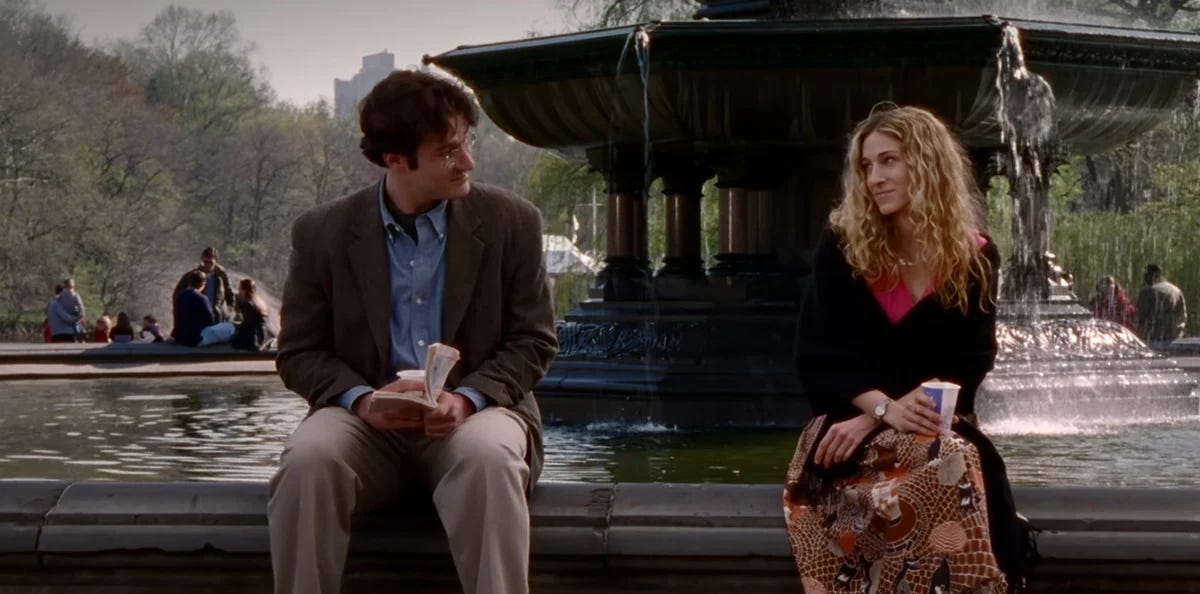
After her dates from hell, Carrie sits in a park alone and, in her voiceover, wonders if she’ll ever meet a non-freak. Suddenly, a handsome man wearing glasses, who vaguely resembles a young Louis Theroux, comes into frame next to her. They get to talking: lamenting about the state of dating and examining why they remain the last two unfreaky people in Manhattan. There was something about this conversation that reminded me of the endless back-and-forths I’ve had, both in real life and on the dread dating app, that Silicon Valley nightmare designed to keep us all lonely and jaded. Conversations that start out benign but eventually turn to how annoying or difficult being single in a post-pandemic landscape has been. Over dinner or coffee, you share war stories of strangers. Neither of you will ever know the names or faces of these former dates, yet intimate details of their inner lives will stay with you far longer than this current first date will. It’s almost sweet, how time is a flat circle and all.
I wonder if dating has always been this bad?
Months ago, my friend Skye, who has listened to me complain while doing my nails for years, reminded me that most people are doomed to pretend they've experienced the worst of the worst, unlike previous generations. This came after me suggesting that avoidant people (myself included) were a plague of the 2020s. When watching Claudia Weill's Girlfriends (1978) a few weeks back, I thought of what Skye said while witnessing women in the 1970s experience a similar level of societal discontent with work, friendship, dating and overall, life. I wonder how different Girlfriends would be if they had access to mobile phones or TikTok theories on why men aren't messaging them back. Would it have made the hardships of friendship breakups, stunted relationships and awkward growing pains of their twenties less difficult? I can't say I know the answer, but technological progress didn't seem to make it any less difficult for the women in Sex and the City, Broad City, Girls, Insecure, I Love LA, and the plethora of shows and movies focused on the ennui of young adulthood—it just created other avenues for the difficulty to exist in.
Sex and the City is not perfect. In her article Post-Feminism and Popular Culture, sociologist and cultural theorist Angela McRobbie suggests that films such as Bridget Jones Diary and shows such as SATC “normalise post-feminist gender anxieties so as to re-regulate young women by means of the language of personal choice.” In SATC, the women are self-empowered, free to date whoever they want, work wherever they want, dress however they want, etc. These are women, twenty or so years removed from second-wave feminism, whose current issues are somewhat frivolous fancies of middle- to upper-class white women who commit themselves to freedom via lunches, bar hopping, and, most importantly, dating. However, the women in SATC aren’t entirely free of expectations. Each character finds themselves worried about gendered burdens, such as the threat of ageing (Samantha), not getting married (Charlotte), and the price of leaning in (Miranda), all filtered through Carrie’s anxiously attached anthropological lens to understand what makes men and women tick. As McRobbie continues, “even ‘well regulated liberty’ can backfire (the source of comic effect), and this in turn gives rise to demarcated pathologies (leaving it too late to have a baby, failing to find a good catch, etc.) which carefully define the parameters of what constitutes liveable lives for young women without the occasion of re-invented feminism.”
And yet, I find SATC a rather perfect point of comparison for my own dating woes. But if you are looking for an interesting and well-written analysis of its political temperament, both in the original show and the sequel series, I’d read this piece by the lovely Charlie Squire.

Ben (the Louis Theroux lookalike) eventually falls for Carrie as she does for him, putting aside any notion of freakiness. However, when Carrie attempts to extend her happiness towards Miranda by inviting her on a double date with Ben and his friend, the cracks begin to show. Ben’s friend is such an obvious freak (never having left Manhattan in ten years) that Miranda immediately uses her bad date code word and leaves, telling Carrie if that man’s a freak, then Ben’s a freak (prompting Carrie’s eventual freakdom). Sadly, Miranda’s immediate realisation of incompatibility isn’t something she continues on with in the show, but there’s something to be said about just getting up and walking out on a bad date instead of wasting another evening.
Despite Miranda’s warnings, Carrie continues to date Ben, and after consummating their relationship, she finds herself left alone in his apartment with a growing urge to investigate any potential freakishness before things get too serious. There she goes on a rampage around his clothes, personal items, fridge and even attempts to open a locked box with a letter blade, trying to find anything to prove this handsome man she’s besotted with is actually a secret freak. When Ben returns to an apartment turned upside down, he asks, “What the hell are you doing?” to which Carrie can only reply, “I don’t know. I was looking for something—something freaky.” It turns out that inside the box lay his Cub Scout badge collection, nothing untoward. “I thought you were actually a normal one,” Ben states, showing a similar lack of tolerance for freaks as Miranda. Carrie’s two-word response, one coloured by shame and desperation, “I was,” reveals the eventual result of succumbing to the freak show. That the line between freak and normal is perhaps much thinner than we’d like to accept.
Have I also fallen down the same rabbit hole? Obviously not to the extent of destroying an apartment, but the feeling that drove Carrie is overwhelmingly familiar. I have also been a victim of my baser instincts, which push me away from flirting with the cute guy at a party because instead of focusing on what he’s saying to me, I’m wondering how he’ll fuck me over in three weeks’ time. I think about what my parents told me growing up, my friends' complaints in our chats, and the tweets/posts from women my age about how their latest dating experience turned into endless torment. I fixate on it, and in the meantime, he moves on to talk to someone more normal than I am. How am I meant to find love when I won’t let someone talk to me? Are they meant to pry me open with force, push me beyond my limits and risk me shutting down entirely?
I’m jaded. Perhaps, in reaction or retaliation to the dating experiences (and ongoing sexual harassment) I’ve been dealing with. I’ve started to pull myself back, and with every inch there’s less left for someone to discover about me. I’m an admitted control freak—I want to be in charge of all variables, including when my heart gets broken. If it’ll happen eventually, should I not take any and all precautions? Weirdly, it’s like when I broke my leg rollerskating as a kid. After months of not being able to walk, I avoided all forms of biking, ice skating, skateboarding and the lot to prevent it from ever happening again. Except that when I was 22, I broke my ankle by tripping on a loose tile in the middle of Holborn. I dropped to the ground in front of a packed Wetherspoons and a crowd of tourists. All those years of precaution went out the window. Here I was, embarrassed, crying and shivering from agonising pain.
I guess that’s the lesson there, it’ll happen either way. Better to be along for the ride than not.
Thank you to my friend Mia for editing this for me. I love you a dozen. You, along with Shaniya, Skye and unnamed others, have listened to me complain for ages, which gave me the inspiration to write it all out.
“I wonder if the longer someone stays single, the weirder they become? And if so, am I also privy to this evolution…” you ate that!
such a perfect summation of how I've been feeling lately, could not have come at a better time